Gathering In - Fall Learner Workbook | Ages 7–14 (Phase 2)
Gathering In - Fall Learner Workbook | Ages 7–14 (Phase 2)
Couldn't load pickup availability
This is a season held in the hands.
Over twelve weeks:
- learners trace the food on their plate back to the hands that grew it
- gather a recipe from someone who loves them
- help plan and host a community feast
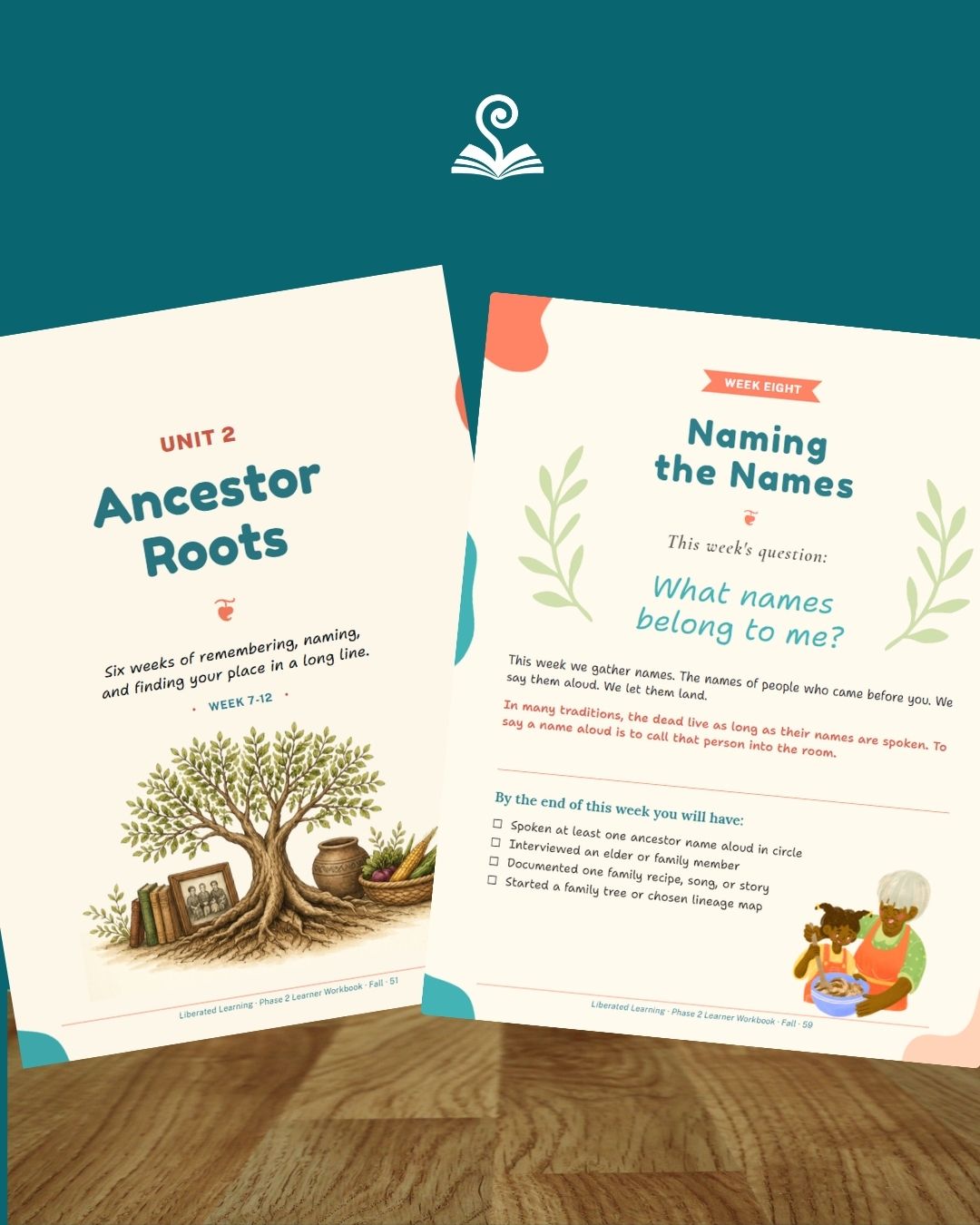
- map their own lineage
- interview an elder
- write a sealed letter to the descendants who will one day trace their lives back to this child
What a week looks like
Monday opens with one question
— What is the food that made you? or What names belong to me? — and that question holds the week.
Then daily pages, Monday through Friday, to write or draw on.
There's a cut-out page: a recipe card, an interview card, an ancestor name card, a land acknowledgment. Those leave the book and go up on a wall, a shelf, a remembrance space.
Then a Friday page — What I noticed this week.
The same shape all twelve weeks.
The work moves through two units
Feeding Our Community · weeks 1–6.
Begins with the food that made us and moves outward through the people who feed us, the question of who eats and who doesn't, and cooking as care. It ends in a Harvest Feast the learner helps create — planned, budgeted, cooked, hosted.
Ancestor Roots · weeks 7–12.
Begins in the body as the first archive of inheritance, then widens through names, lineage, land, and what it means to become a good ancestor. Learners meet the Four Directions of Ancestry — blood, spirit, place, and future — so no child is locked out by a family tree they can't fill in. It ends in a Storytelling Ceremony where names are spoken aloud.
The academics
Woven through every week, never drilled:
- Reading and writing — interview questions, invitation letters, menus, a letter to descendants, research notes
- Math — scaling recipes, measuring ingredients, budgeting the feast, headcount and servings
- Science — nutrition, agriculture and supply chains, food preservation, how heat changes food
- Social studies — food sovereignty, agricultural labor, oral history, Indigenous land and presence
- Practice — interviewing, cooking, public speaking, hosting
The promise on every page
There are no wrong answers, only the learner's own. Pages can be skipped and returned to. Drawing counts as much as writing, and saying it out loud for someone else to write down counts too. The book is built for the child opening it.
The way this works
- Time: 30–60 minutes a day, five days a week. Four-day households combine Wednesday and Thursday. Slower is fine — there is no behind.
- One book per learner. The pages are personal. Siblings work side by side in their own copies.
- Age fit: 7s and 8s need an adult reading and scribing alongside them. 12s to 14s should take the STRETCH prompts, which go past the page rather than repeat it.
- Mixed ages: built for it. Older learners mentor younger ones through the same weekly rhythm.
- Materials: most of the season runs under $20, much of it on what you already have.
- What it isn't: no arithmetic drill, no phonics, no spelling lists. It's a season, not a full-year core. Most families run it as their anchor and keep a separate math program going. Some run it three days a week alongside school.
Includes the Fall Facilitator Workbook, free
The companion for the adult holding the season — how a week runs, how to set up a remembrance space, what to do when it falls apart, and notes of care for the two tender weeks. Free with every learner workbook.
Learning is remembrance.
Share